


𝗧𝗵𝗲 𝗦𝗺𝗮𝗹𝗹 𝗪𝗼𝗿𝗱𝘀 𝗧𝗵𝗮𝘁 𝗕𝘂𝗶𝗹𝘁 𝗠𝘆 𝗣𝗿𝗼𝗳𝗲𝘀𝘀𝗶𝗼𝗻𝗮𝗹 𝗖𝗿𝗲𝗱𝗶𝗯𝗶𝗹𝗶𝘁𝘆

What if your apology is costing you respect? In this blog, I share 6 unprofessional phrases I replaced over 40 years—from "My bad" to "I take responsibility"—that changed how clients perceived me. I also share a live WhatsApp DM I sent today, where placing the apology in the middle instead of at the start got me an instant acknowledgement.

What my 30-year-old self said vs. what my 70-year-old self says
In my early 30s, when I arrived late at my office (bank branch), I would say, "Sorry I'm late," with an awkward smile and hope it would be forgotten.
In my 70s, trying to sound modern with my younger team, I would say, "My bad," when a figure went wrong.
It took me 40 years in the profession to understand—your apology doesn't just forgive a mistake; it defines your professionalism.
Recently, I came across a simple chart: "Replace These Unprofessional Apologies." It took me back through the decades of my own journey.
How replacing 6 casual phrases changed how clients perceived me
Let me share what I learned in each phase:
1. When you reply late
INSTEAD OF: "Sorry for not replying."
TRY: "I apologize for the delayed response."
My learning at age 35: As a young and qualified Company Secretary, I once delayed a reply. My casual "Sorry" made the client feel his work was not important.
2. When you make a mistake
INSTEAD OF: "My bad."
TRY: "That was my mistake."
My learning at age 40: In a Board Meeting, I said "My bad" for a wrong figure. My Company Chairman said, "You are a professional, not a college boy." I stopped it forever.
3. When your work contains an error
INSTEAD OF: "I messed up."
TRY: "I take responsibility for the error."
My learning at age 50: Saying this built more trust than 10 perfect reports.
4. When you forget something
INSTEAD OF: "Oops, I forgot."
TRY: "I apologize—it slipped my mind."
5. When you arrive late
INSTEAD OF: "Sorry, I'm late."
TRY: "I apologize for being late."
6. When you cause inconvenience
INSTEAD OF: "Sorry for the trouble."
TRY: "I apologize for the inconvenience."
A 40-year professional lesson in 5 minutes
The Real Art: Where to Place Your Apology—My Direct Message (DM) on WhatsApp Today
This morning itself I had to use this art.
I received a warm invitation for the 30 Years celebration of a fellow CS Associates firm. I could not attend due to age-related inconvenience.
The important point here is I did not begin my message with an apology.*
If you start with "Sorry I could not come," the reader's mind stops there. Instead, I created inquisitiveness—why apology. Didn't he come when he valued us so much?
I revealed the reason in the middle of the message. The result? An instant, warm acknowledgement to my DM.
Here is the exact DM. I sent:
"My heartfelt thanks for your warm and personal invitation for the 30 Years celebration of CS Associates, and more so for remembering me as your contemporary. It truly touched my heart.
Thirty years is not just a milestone—it is a legacy of dedication, values, and professional excellence that you, CS RB (former partner), CS RG and others have built together, hand in hand. As one who has walked a parallel professional journey, I can deeply appreciate the perseverance and integrity behind this success.
Hearty congratulations on this glorious occasion! 🎉
I had earnestly planned to attend and personally convey my wishes with a small memento for your office. Due to age-related inconvenience, I could not make it and missed your gracious hospitality.
Your remembering me as a contemporary since 1991 is an honour I will always cherish. My best wishes for many more years of success."
Notice the structure: Gratitude -> Value -> Celebration -> Apology in the middle -> Honor at the end. The apology didn't weaken the message; it strengthened the relationship.
My learnings from age 65 onwards: Age gives you wisdom, but words and their placement give you respect.
Pros and Cons
Pros: Builds credibility, shows accountability, and clients trust you more.
Cons: If overused or used with close friends, it can sound too formal and lose sincerity.
The fastest way to grow your career isn't another degree. It's learning how to communicate with confidence.
I have shared this art in my book Power Intro: The Art and Science of Positioning Yourself in the First 120 Seconds.
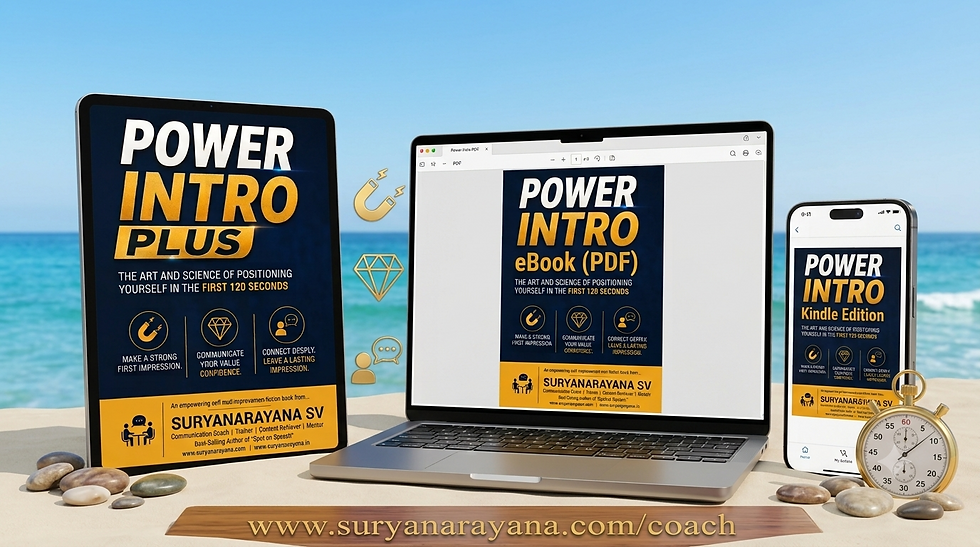
1. Power Intro — Amazon Kindle Edition
Title: Power Intro: The Art and Science of Positioning Yourself in the First 120 Seconds
A practical guide to creating a confident, clear, and memorable professional introduction. Learn to communicate your value, capture attention, avoid common mistakes, and turn introductions into opportunities through practical frameworks and coaching insights.
Borrow on Amazon Kindle Unlimited: https://amzn.to/4xcGi7d
2. Power Intro — Standard PDF Edition
Title: Power Intro (eBook): The Art and Science of Positioning Yourself in the First 120 Seconds
The complete written guide for readers who want to master their professional self-introduction. It covers first impressions, the Hook–Value–Bridge framework, attention-grabbing hooks, common introduction traps, and preparation for personalized coaching.
3. Power Intro Plus — Premium PDF Edition on Gumroad
Title: POWER INTRO PLUS - The Art and Science of Positioning Yourself in the First 120 Seconds [Premium Visual Infographic Edition]
Includes the complete PDF ebook plus five A4 chapter-wise visual infographic summaries. These help readers revisit the key concepts, reinforce learning, and retain the frameworks for future reference on mobile devices or in print.
Get Power Intro Plus on Gumroad: https://suryanarayanasv.gumroad.com/l/power-intro-plus-ebook
This blog is part of my upcoming ebook series "Strengthen Self-Improvement"—because self-improvement is not a subject; it is a daily practice.
Do you have such words that you changed in usage and that worked? Write in comments.


Comments